


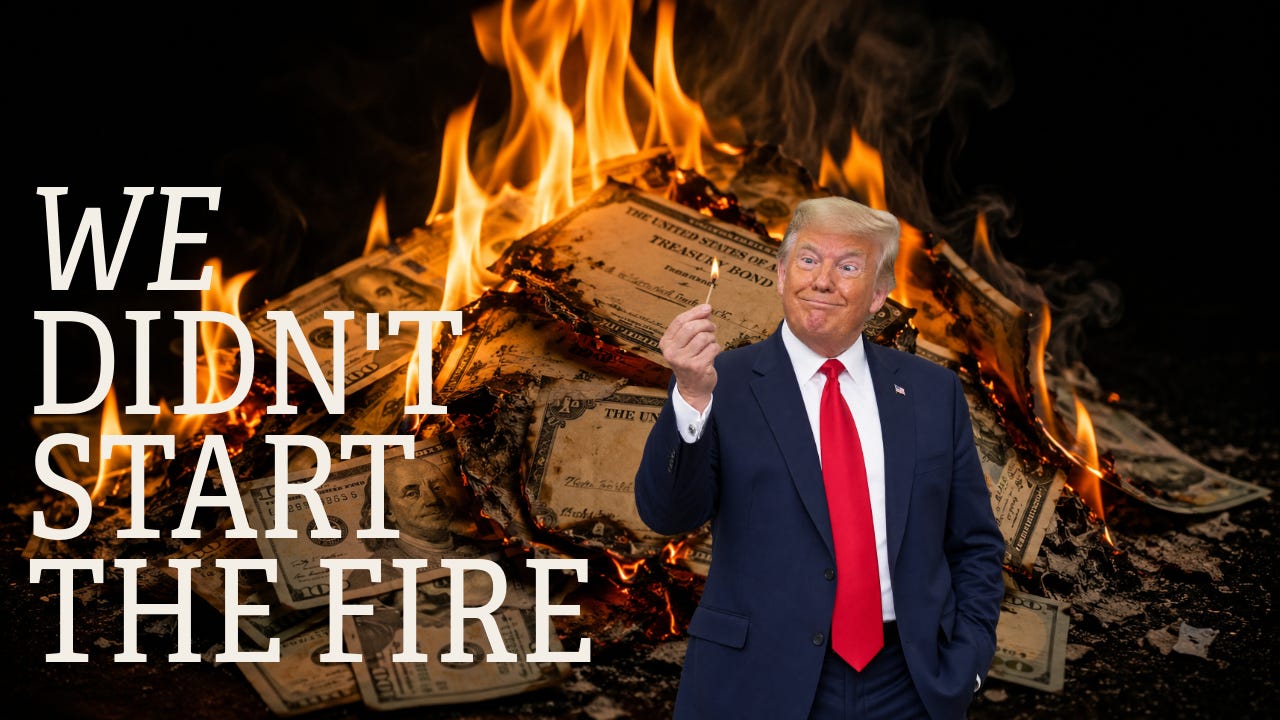
Every government bond market on Earth is puking at the same time, and it is not a coincidence. Japan’s ten-year yield crossed 3 percent on Tuesday for the first time since 1996—the last time that happened, Independence Day was in theaters and the Macarena was a threat to national security. British ten-year gilts are at 5.25 percent, a number last seen in 2008, when Lehman Brothers was still technically a company. Germany is at its highest since 2011, France since 2008, and the U.S. ten-year Treasury is flirting with 4.8 percent while the thirty-year sits at 5.27 percent. Bloomberg’s gauge of global government yields hit 3.72 percent, the highest since mid-2008. And wouldn’t you know it, every one of those years was the one right before something blew up.
Who Set the Fire
The scheme isn’t complicated. Yields go up when investors decide a government is a worse bet than it was yesterday. So what changed? Three things, and one man’s fingerprints are on all of them.
First, the United States blew past forty trillion dollars in debt, the deficit is running near two trillion a year, and the interest bill alone is pushing toward one point two trillion—which is to say we now pay more to service the credit card than we spend on the entire fucking Pentagon. Second, tariffs, the tax you pay at Target so a guy in a red hat can call it winning. Third, a shooting war with Iran that has the Strait of Hormuz on a coin flip and Brent crude at ninety-five dollars a barrel, up 41 percent in a year. European natural gas is at its highest since March. Eurozone inflation is back above 3 percent.
Wars are inflationary. Tariffs are inflationary. Borrowing two trillion dollars a year you don’t have is inflationary. Volcker knew this. Reagan knew this. My eighth-grade social studies teacher knew this, and she also thought Red Dawn was a documentary.
The Guy He Hired to Cut Rates Is About to Raise Them
Kevin Warsh is Fed chair because Donald Trump wanted a Fed chair who would cut rates. Trump said so out loud back in February: he wouldn’t have picked Warsh if he wanted hikes. Then Warsh got to Jackson Hole last Friday and said, and I quote, “The responsibility for 65 months of sustained, elevated inflation sits squarely with the central bank,” followed by, “Otherwise, we have work to do.” Traders heard “work to do” and priced a September hike at 66 percent. Fed Governor Michael Barr is promising to “act decisively” at the September 15–16 meeting.
Sixty-five months. Five and a half years above target. This inflation is old enough for kindergarten, and both parties have babysat it. But only one of them decided the cure was a trade war and an actual war.
Then Monday, in the Oval Office, a reporter asked Trump whether he opposed Warsh raising rates. “I have a lot of respect for him, and he’ll do what he has to do,” said the president, and then—in the same breath, practically the same fucking sentence—”I think our interest rates are too high,” and we “should have the lowest interest rates in the world.” That is a man who set his own kitchen on fire explaining to the firefighters that the water is too cold.
Meanwhile, Treasury Secretary Scott Bessent says worries about the debt “overlook the strength of the U.S. economy,” which is a hell of a thing to say while your own department launches a buyback program for long-dated Treasurys to keep the thirty-year from going full Chernobyl. If the economy were that strong, Scott, you wouldn’t need to buy your own bonds. That’s not confidence. That’s a guy buying his own album to get on the charts.
And Now the Part That Should Actually Scare You
The bond market is the plumbing. Nobody looks at the plumbing until it backs up into the living room. And what’s sitting in the living room right now is the largest pile of borrowed money in the history of the species, wearing a T-shirt that says AI.
Hyperscaler bond issuance is up 973.7 percent this year—$225 billion dollars so far, on pace for $400 billion. Alphabet, Meta, Amazon, and Oracle alone have borrowed more than $300 billion since early 2025. Nvidia just did its first bond sale in five years: twenty-five billion. And that’s only the debt they admit to. A Nikkei study found $1.65 trillion dollars in off-balance-sheet obligations at the big U.S. tech firms, eight hundred twenty billion of it tied to data centers that aren’t even built yet. Citi says AI investment has accounted for more than half of real GDP growth in recent quarters. More than half. The economy Bessent is bragging about is a data center with a bond stapled to it.
Bubbles don’t pop because somebody notices they’re bubbles. They pop when the money gets expensive. In February, investors were lining up five deep for hyperscaler bonds. By July it was under two, and Amazon had to pay extra just to get its deal done. Now the risk-free rate—the number every one of those trillion-dollar bets is priced against—just hit its highest level in eighteen years. Every AI capex model in Silicon Valley was built on cheap money, and cheap money has left the building like Elvis.
This could be the beginning of the AI bubble popping, and if it is, 2008 is going to look like a picnic with rainbows and lollipops and unicorns. In 2008 the rot was in mortgages, and the government could still borrow its way out because Treasurys were the safe place to run. Where do you run when Treasurys are the problem? When Japan—”the anchor for global fixed income,” per TD Securities’ Prashant Newnaha—has “flipped”? That’s not a correction. That’s the floor.
Verdict
I remember 2008. I remember people who did everything right losing everything anyway, while the guys who built the bomb got bonuses. I remember the dot-com crash before that, when a whole generation of my friends learned what “vested” meant the hard way. I have the tape. This is a rerun.
So here is the cold part. Nobody in this administration has said the word “deficit” with a straight face in a year. The Fed chair the president hired to make money cheap is about to make it expensive, because the president made everything else expensive first. And the one industry holding the whole economy up is borrowing against buildings that don’t exist yet.
The bond market isn’t panicking. It’s doing math.
The panicking is our job.
Thanks for reading!
We’re Dana DuBois and Lawrence Winnerman, lifelong BFFs and co-hosts of The Daily Whatever Show — our independent home for smart, irreverent conversations about culture, politics, media, creativity, relationships, aging, and whatever else is shaping modern life this week.
We’re live every weekday at 10am ET with thoughtful analysis, sharp interviews, cultural commentary, humor, and the kind of conversations that don’t pretend everything is fine when it clearly isn’t.
If you’re enjoying what we’re building, please consider supporting our work with a paid subscription. Your support helps us keep the show independent, book fascinating guests, and continue creating smart conversations with your morning coffee.
We love you — mean it!

Glad you are speaking about this.
This essay is excellent! This is fair warning to everyone who is not paying attention. Thank you for this!