


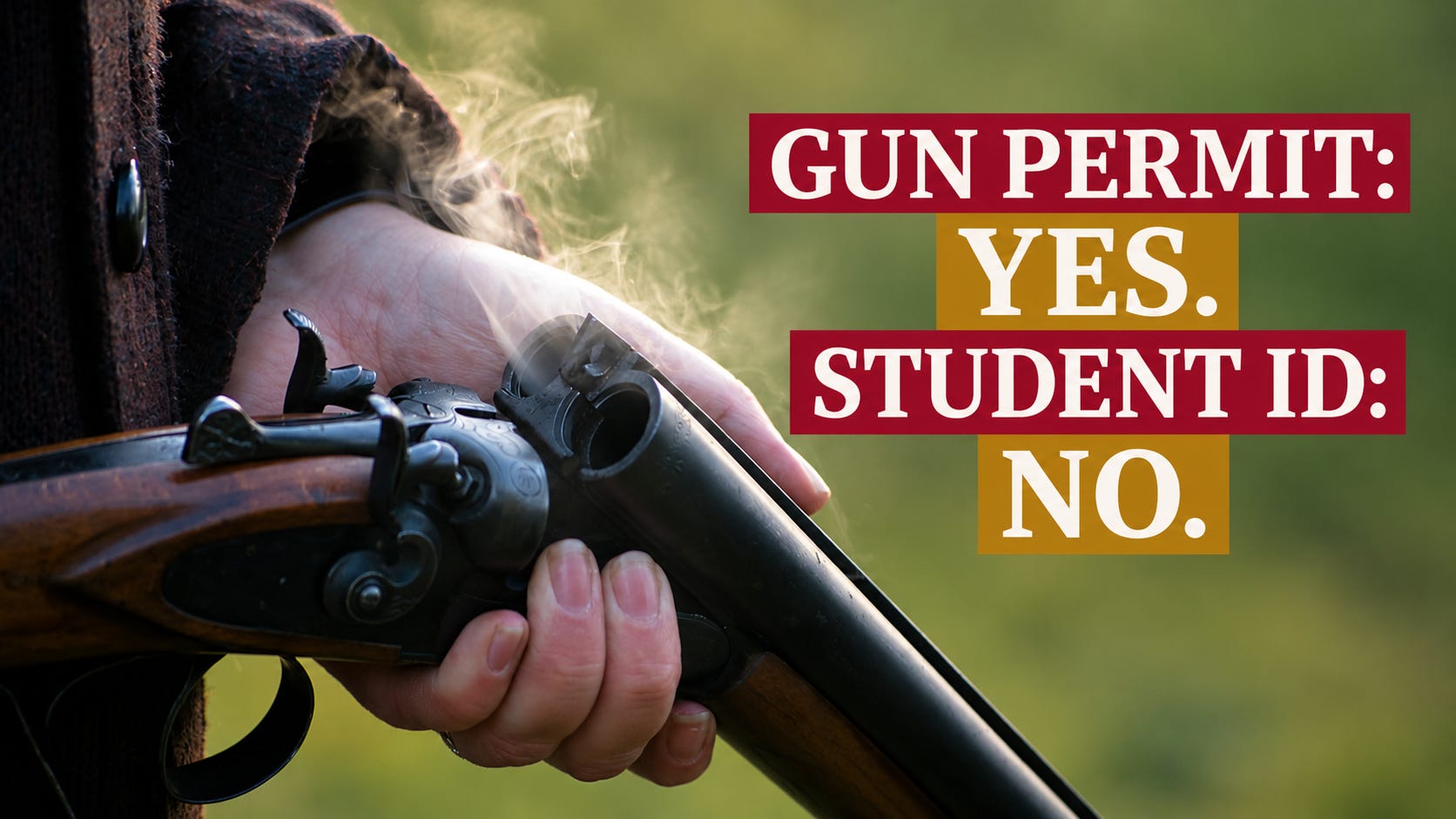
TALLAHASSEE, FLORIDA, AT THE LAMINATING MACHINE IN THE REGISTRAR’S OFFICE (The Daily Whatever Press) — On Friday, October 16, the Florida State Conference of the NAACP’s branches and youth units sued Florida’s secretary of state, Cord Byrd, and all 67 county supervisors of elections in federal court in Miami. The target is one line in a new state election law: the one that says a student ID can no longer be used to vote.
We read the law so you don’t have to. Our newsroom would like to report that it made us feel old and furious in equal measure.
The law is HB 991, which the Republican-controlled Legislature passed largely along party lines on March 12 and Gov. Ron DeSantis signed on April 1, 2026, at a press conference in The Villages. Yes, the retirement community. We are choosing not to make the obvious joke about where you hold the signing for a bill that keeps 19-year-olds from voting. We are only noting it.
(Sound of a laminator jamming.)
What still counts
Under HB 991, starting January 1, 2027, here is some of what you can still show a poll worker in Florida: a Florida driver’s license or state ID, a U.S. passport, a military ID, a veteran’s health ID, and a concealed weapons license. Other government IDs are fine too, according to the complaint, “except one issued by an educational institution.”
So the state of Florida trusts the card that says you may carry a hidden handgun. It does not trust the card the University of Florida, which is also the state of Florida, printed for a sophomore. And this one is personal. I went to The University of Florida. So did Lawrence Winnerman. All the way, Fightin’ Gators — we’re thrilled to see you fight for this one! But we’re so dismayed you have to.
Oh, and the law also tosses retirement-center IDs, debit and credit cards, and neighborhood-association IDs. But the student ID ban is the one aimed squarely at people under 25.
The governor’s reason
DeSantis explained it at the April signing. According to the NAACP’s complaint, he said: “a student ID doesn’t mean you are a resident of the state of Florida. Student ID means you’re going to school.”
That would be a reason, if residency were the test. It isn’t. A U.S. passport doesn’t prove you live in Florida. A military ID doesn’t prove you live in Florida. The complaint makes exactly this point, arguing that “most forms of voter ID that HB 991 still allows likewise do not prove Florida residency.”
Meanwhile, the state’s own count of what all this is supposed to stop: 198 “likely noncitizens” among more than 13 million registered voters in 2025, according to the Florida Phoenix and Courthouse News. That’s about 0.0015%. Our math desk ran it twice. What can I say, that UF undergrad diploma means we’ve got smarts!
State Sen. Erin Grall, who carried the bill in the Senate, argued on the floor, according to the complaint, that “almost anyone can print an ID card in their house” and that student IDs are “not as trustworthy as a government issued ID.” Florida’s public universities are government institutions. When pressed about a compromise for public-university IDs, Grall said the provision was “important to the House.”
Important to the House. That’s it. That’s the justification.
Who gets caught
The NAACP’s complaint says “tens of thousands” of the state’s youngest voters hold student IDs, and that thousands of them likely don’t have any other ID the law will accept. Democracy Docket, citing federal highway and census data, reports that more than 1.4 million Floridians aged 18 to 24, roughly a quarter of that age group, had no driver’s license in 2024. Florida State alone has about 35,000 undergraduates. The University of Florida has more than 40,000 undergraduates.
Think Fast Times at Ridgemont High, but the kid without a car is the one who doesn’t get to vote.
Democratic state Sen. LaVon Bracy Davis asked the question on the Senate floor that the Legislature never answered: “When did students become the enemy?”
We would like to answer it for her. It was around the time young voters started voting the wrong way.
What the lawsuit says
The NAACP’s suit makes three claims: that the ban violates the 26th Amendment, which says the right to vote can’t be denied “on account of age” to anyone 18 or older; that it violates equal protection under the 14th Amendment; and that it puts an undue burden on the right to vote. It asks the court to block the provision.
The 26th Amendment was ratified in 1971, after a generation of 18-year-olds was told it was old enough to be drafted for Vietnam but not old enough to vote. Florida has found a way to run that logic in reverse: old enough to vote, just not with the ID your state university gave you.
On timing: this ban does not apply to the November 3, 2026, election. It takes effect January 1, 2027, so the first big statewide test is 2028. Earlier challenges to the rest of HB 991, brought by the League of Women Voters and other groups (represented by the ACLU) and by the NAACP itself, are consolidated and still pending in federal court in Miami.
At the signing, DeSantis said of the lawsuits, “I sign it, they sue us.”
Yes, Governor. That’s how it works when you sign something this obviously aimed at students.
The newsroom’s verdict: a concealed carry permit is good enough to vote in Florida and a state university ID is not, and Ron DeSantis signed that into law to make it harder for young people to vote.
Hi, I’m Dana — and I Write Out Loud
I Write Out Loud is my primary home for cultural memoir, personal essays, and live conversations about the strange, brave process of becoming yourself in midlife. If you like essays with a point of view and apex pulse, you’ll find plenty to read there.
And if you enjoyed this story — why not buy me a coffee? ☕
{Make mine a decaf iced oat milk mocha, please!}
Thanks for stopping by!
We’re Dana DuBois and Lawrence Winnerman, lifelong BFFs and co-hosts of The Daily Whatever Show — our independent home for smart, irreverent conversations about culture, politics, media, creativity, relationships, aging, and whatever else is shaping modern life this week.
We’re live every Friday at 10am ET with thoughtful analysis, sharp interviews, cultural commentary, humor, and the kind of conversations that don’t pretend everything is fine when it clearly isn’t.
If you’re enjoying what we’re building, please consider supporting our work with a paid subscription. Your support helps us keep the show independent, book fascinating guests, and continue creating smart conversations with your morning coffee.
We love you — mean it!
