



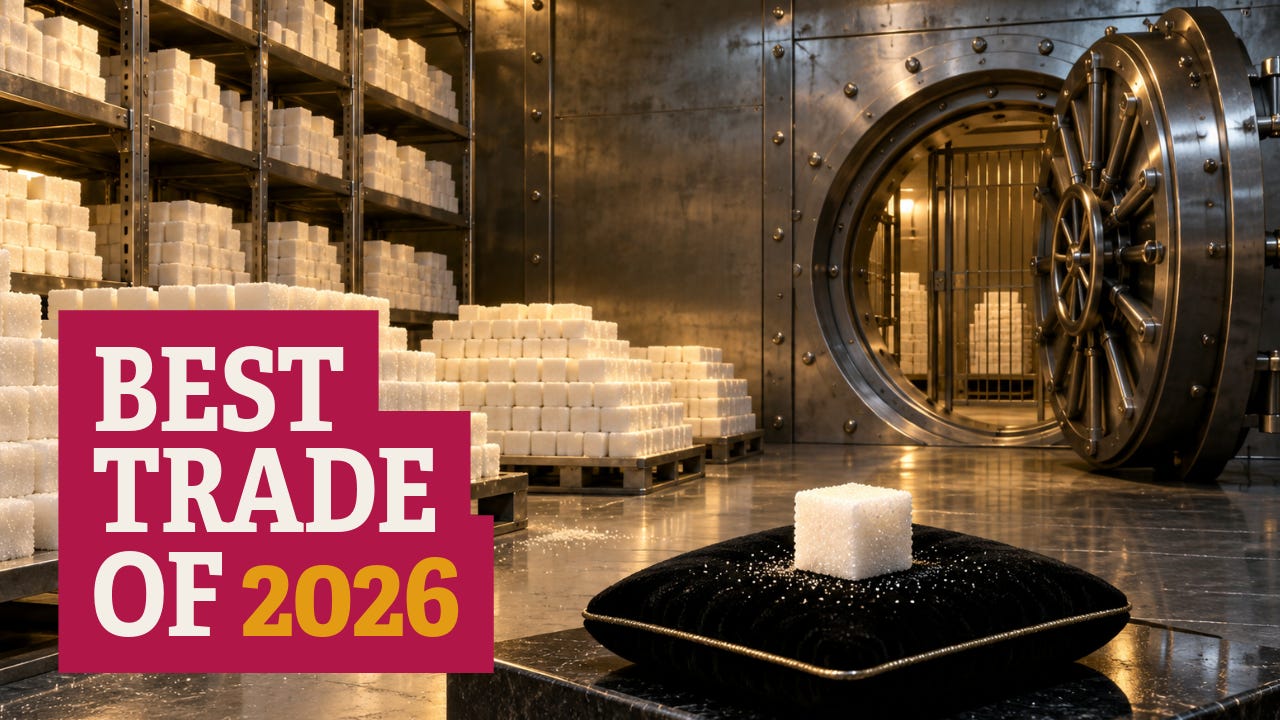
BRASILIA, BRAZIL (The Daily Whatever Wire) The best-performing asset in America this year is not a chip company. It is not a data center, a stablecoin, or a nuclear reactor with a hyperscaler tenant. It is sugar. Plain, granulated, the stuff in the blue box on your grandmother’s counter. Known on the black market by the street-drug name “sucrose”, or simply “S”, the tempting white powder is up roughly twenty percent in 2026 against the S&P 500’s thirteen. In August alone it rose 21.5 percent, its strongest month since October of 2010, which means the sweetener aisle just outran the entire artificial-intelligence complex while wearing sandals and screaming “wheeeeeee!”
The financial press has taken this seriously, which is the funniest part. Citi named sugar its highest-conviction bullish call in agricultural commodities and raised its three-month target to nineteen cents a pound. Citi’s Arkady Gevorkyan warned that “Brazil remains the market’s key balancing supplier, but weather-related execution risks during the remainder of the harvest leave little margin for error,” a sentence that means it might rain. The European Commission expects EU beet production to fall nineteen percent, to 13.4 million metric tons. India, which is supposed to sell sugar, has instead authorized a million metric tons of duty-free imports. Brazil, with oil above ninety dollars a barrel, is burning its cane as ethanol instead of selling it as dessert. Barchart’s William Osnato summarized the whole picture: “They’re all going in the same direction. They’re all increasing the deficit.”
Every kid my age already learned this lesson in a movie theater in 1983.
In Trading Places, Randolph and Mortimer Duke bet a dollar that they could ruin one man’s life and elevate another, and then tried to corner frozen concentrated orange juice using a stolen crop report. We all laughed, because the premise was preposterous: two withered old men in a private club deciding the price of breakfast. Eddie Murphy explained the pork-belly market to a room of adults and it played as farce.
I have since launched a fund.
Confectioners Alpha is a long-only sucrose vehicle with a satellite-imaging overlay and a twelve-person team that does nothing but photograph Brazilian weather. Our September letter to investors described the thesis as “structurally short Halloween.” Our risk disclosure notes that the portfolio may, under stress conditions, be eaten. The junior analyst who built our beet model has developed a tremor. Last week he stood up in the middle of the morning meeting and said, quietly, “Thailand,” while snorting Pixie Stix and then sat back down, and we added to the position, because that is what conviction looks like in this business.
None of which matters, because here is the part the market reports leave out.
There is no free market for sugar in the United States. There hasn’t been one in my lifetime. The Department of Agriculture sets an Overall Allotment Quantity that reserves eighty-five percent of the American market for American producers, split 54.35 percent beet and 45.65 percent cane, then parceled out to individual processors like communion. It lends against sugar at 18.75 cents a pound for cane and 24.09 for refined beet, which functions as a price floor. Imports over a quota of 1.231 million tons get hit with tariffs north of fifteen cents a pound. And under the Feedstock Flexibility Program, when there is too much sugar, the government buys the surplus and sells it at a loss to be burned as fuel.
The most aggressively rigged commodity in the country just became its hottest trade. Cato put the consumer cost of the program at somewhere between $2.4 billion and $4 billion a year, and the food-manufacturing job losses at seventeen to twenty thousand annually. Those are the fees. You’ve been paying them at the register since the Reagan administration.
Which brings us to the real-life sugar Dukes.
Alfy and Pepe Fanjul own roughly 400,000 acres of cane, half in Florida and half in the Dominican Republic, and their American Sugar Refining sells you Domino, C&H, and Florida Crystals. They control sixty-three percent of the Dominican Republic’s sugar export quota to the United States. The sugar industry has put more than $40 million into American politics since 1990, fifty-seven percent of it to Democrats and forty-three percent to Republicans, and the brothers have divided the labor accordingly: Pepe funds the Republicans, Alfy funds the Democrats, and no matter who wins the allotment survives.
And then, in the summer of 2025, the president of the United States announced he had personally persuaded Coca-Cola to switch its American product from corn syrup to cane sugar. Coke confirmed it. The cane version rolled out that October. A health initiative, we were told. Totally not a flashback to the disaster of New Coke, amirite? Bill Cosby was notably absent for the switchback.
Sugar is now up twenty percent and Citi is telling clients to buy more.
In Trading Places, the Dukes needed an inside man, a forged crop report, and a doctored envelope to move one commodity for one morning. The Fanjuls just needed a farm bill.
Thanks for reading!
We’re Dana DuBois and Lawrence Winnerman, lifelong BFFs and co-hosts of The Daily Whatever Show — our independent home for smart, irreverent conversations about culture, politics, media, creativity, relationships, aging, and whatever else is shaping modern life this week.
We’re live every weekday at 10am ET with thoughtful analysis, sharp interviews, cultural commentary, humor, and the kind of conversations that don’t pretend everything is fine when it clearly isn’t.
If you’re enjoying what we’re building, please consider supporting our work with a paid subscription. Your support helps us keep the show independent, book fascinating guests, and continue creating smart conversations with your morning coffee.
We love you — mean it!
