


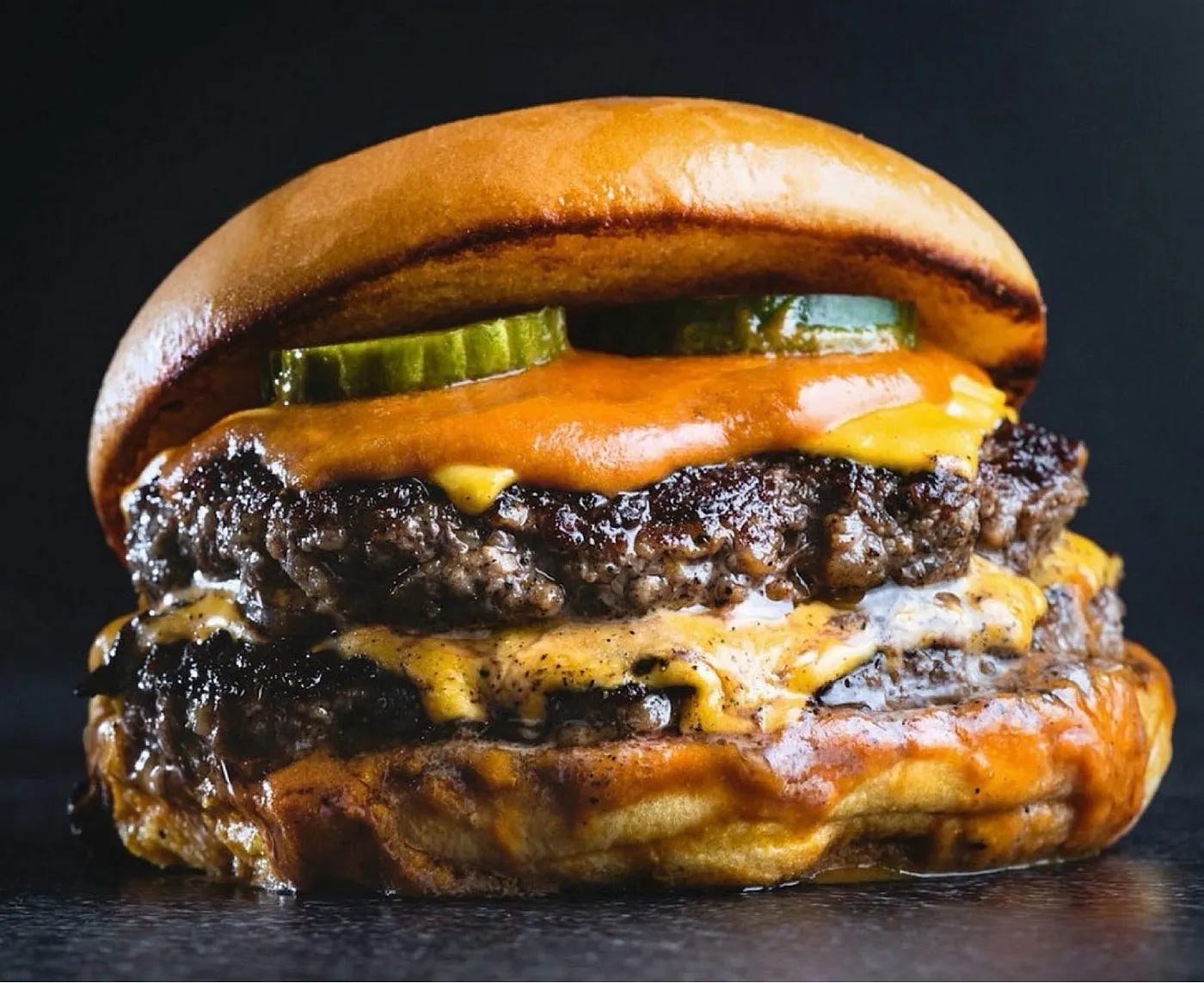
What’s the beef about?
WASHINGTON D.C. (The Daily Whatever News Wire)—Trump announced a deal to make beef cheaper by allowing up to 300,000 metric tons of imported ground beef in without the usual out-of-quota tariff.
He framed it as relief for grocery shoppers, saying beef prices had “soared” under the previous administration, the American cattle herd had shrunk to its smallest size in modern history, and the imported beef would sell for 25% below current market prices.
Beef. It’s what’s for dinner. And now, apparently, it’s going to be cheaper. Americans have historically been trained to regard this as good news.
Then somebody asked where the beef was coming from.
Trump said: “I don’t want to say.”
Which is not, traditionally, how meat works.
Meat is famously labeled. You can buy a package of hamburger and find out its fat content, its weight, its sell-by date, and, depending on the product, whether the cow had a fulfilling childhood.
But the country supplying 300,000 metric tons of it?
Apparently that’s classified.
I have questions.
Apparently, the beef has a security clearance.
Trump’s answer was “I don’t want to say.” Not “we’re still finalizing the paperwork.” Not “check back after the executive order drops.”
This is not classified information. It’s not a national security briefing. He just asked which countries are entering this deal to provide us with the ground beef. Grocery shoppers have historically been allowed to know this. It’s on the label. The administration’s position, apparently, is that the label is need-to-know — and the public doesn’t need to know.
The White House says an executive order is coming within two weeks, so technically the information exists somewhere and is simply being withheld on a schedule of the administration’s choosing. Why the lack of transparency?
What we do know: almost two-thirds of current fresh beef imports already come from Mexico and Canada, with a substantial share from Australia and Brazil, and rising shipments from Nicaragua, New Zealand, and Argentina. Trump floated importing more Argentine beef back in October, and Argentina’s president is a Trump ally who has been publicly cheerful about deepening the relationship.
So Argentina is plausible. It’s not confirmed. Nobody in this administration has confirmed anything, because apparently the beef has entered witness protection.
But Argentina is the country that keeps surfacing. And that would be less interesting if Argentina hadn’t also had a bit of a beef-related embarrassment this year.
In March, Chinese customs rejected a 22-ton shipment of beef from an Argentine plant after detecting chloramphenicol — an antibiotic that’s been banned in food animals since 1995 because of its link to serious blood disorders, including a rare and potentially fatal condition where the body stops making new blood cells. China operates a zero-tolerance policy on this particular antibiotic: any detectable trace triggers a rejection, no matter how small.
Which, to be clear, is not an ideal thing to discover in something people intend to put in tacos.
Argentina’s food safety agency is investigating, and has floated the possibility of a false positive or an isolated contamination event, since more than 40,000 prior samples had shown no issue. That’s a real possibility. It’s also worth noting that “we think it might be a false positive” is not the same sentence as “we have confirmed it was a false positive,” and as of this writing, nobody has confirmed the second sentence.
One plant. One shipment. Twenty-two tons.
Not an epidemic. Not evidence that Argentine beef is broadly contaminated. Just one plant, one shipment, one very unfortunate lab result.
It’s not evidence that Argentine beef, broadly, is contaminated. It is evidence that at least one facility exporting Argentine beef this year failed a food-safety check that other countries take seriously enough to have a zero-tolerance rule for.
Whether that facility, or others near it, are part of whatever “a few countries” means in Trump’s beef deal is a question nobody currently in a position to answer has chosen to answer.
It’s not a great look.
And then there are the horses…
I know, I know. At this point, this essay sounds like it was generated by a drunk conspiracy theorist with a PETA membership. It was not.
Running parallel to all of this, and reported by an entirely different set of journalists working on an entirely different story, is a New York Times investigation into what’s happening to America’s wild horses.
The Bureau of Land Management’s Wild Horse and Burro Sale Program sold about 3,700 horses in 2025 — more than double the number sold the year before — some for as little as twenty-five dollars a head.
BLM policy states it doesn’t sell or send wild horses to slaughter, and the agency maintains it hasn’t. But livestock inspection records reviewed by the Times connected government-sold mustangs to auctions frequented by slaughter buyers, and from there, to trucks bound for slaughter plants in Canada, since the U.S. hasn’t had a horse slaughter industry of its own since 2007.
We have no evidence BLM knowingly sold horses into a slaughter pipeline.
The open question — the one bipartisan lawmakers are now asking for an investigation into — is whether the agency built a loophole wide enough that it didn’t have to know, and looked away accordingly.
And sure, that’s a meaningfully different accusation than “the government is turning wild horses into ground meat,” and it deserves to stay meaningfully different, because collapsing it into a tidier, scarier story does nobody any favors.
Least of all the horses.
Now, before the fact-checkers circle: no, I’m not stating the beef is contaminated, nor that it’s horse meat.
I’m suggesting that when the White House won’t tell the truth, the difference between a fact and rumors gets blurry, and you can’t help but start connecting dots that possibly, maybe could make sense.
In the meantime… ground turkey, anyone? At least turkeys don’t come with a live-export slaughter pipeline attached.
Yet.
Thanks for reading!
We’re Dana DuBois and Lawrence Winnerman, lifelong BFFs and co-hosts of The Daily Whatever Show — our independent home for smart, irreverent conversations about culture, politics, media, creativity, relationships, aging, and whatever else is shaping modern life this week.
We’re live every weekday at 10am ET with thoughtful analysis, sharp interviews, cultural commentary, humor, and the kind of conversations that don’t pretend everything is fine when it clearly isn’t.
If you’re enjoying what we’re building, please consider supporting our work with a paid subscription. Your support helps us keep the show independent, book fascinating guests, and continue creating smart conversations with your morning coffee.
We love you — mean it!

Carnitas it is then.
That's why I only eat meat and eggs raised on the island. That stuff from the Mainland is vile.