


SEATTLE, WASHINGTON, MY HOMETOWN AND THE GREATEST PLACE I KNOW (The Daily Whatever Press)—In a world that’s been bleak as fuck, on a Substack best known for “Unhinged But Accurate” news, I want to prepare you. What I’m about to type is actually—dare I say it? I do!—good news. Wholesome, life-affirming, fucking-hell-this-is-what-the-world-is-supposed-to-be-like great news.
I know, I’m disoriented too. But let me guide you into a world of music and song and belonging, in a city I’ve been proud to call my own for 30 years now, Seattle.
A choir is one of the most gendered rooms you can walk into.
If you haven’t sung in a choir since high school, you may have forgotten that the first thing that happens is you get sorted. Sopranos and altos on one side, tenors and basses on the other, and for most of choral history those sections have doubled as a gender map.
Women high, men low.
Conductors talk to the room that way. Concert dress codes are built that way. Whole libraries of sheet music assume it.
For a trans singer, that structure can turn every rehearsal into a minefield. Kaelee Bolme, who helped found the Seattle Trans and Nonbinary Choral Ensemble (STANCE), told KING 5 that in a mostly cis choir, sitting in the tenor or bass section, you never know when a director is going to “call out men and ruin your day.” That one careless instruction is enough to remind someone that the room wasn’t built with them in mind — and plenty of people decide it’s easier not to sing at all.
Then there’s the voice itself. Testosterone can drop a singer’s range in ways that leave them unable to hit notes they’ve sung for years, and voices in transition don’t fit neatly into any of the four boxes. Sandi Hammond, who founded one of the country’s first trans choirs in Boston, has described the trans voice as an entirely new instrument. Her chorus ended up rearranging its music so singers with changing ranges could actually sing it, and built a body of trans-accessible repertoire that other groups could use.
That’s what these choirs are doing at the most practical level. They’re making room for voices that the traditional system doesn’t have a section for.
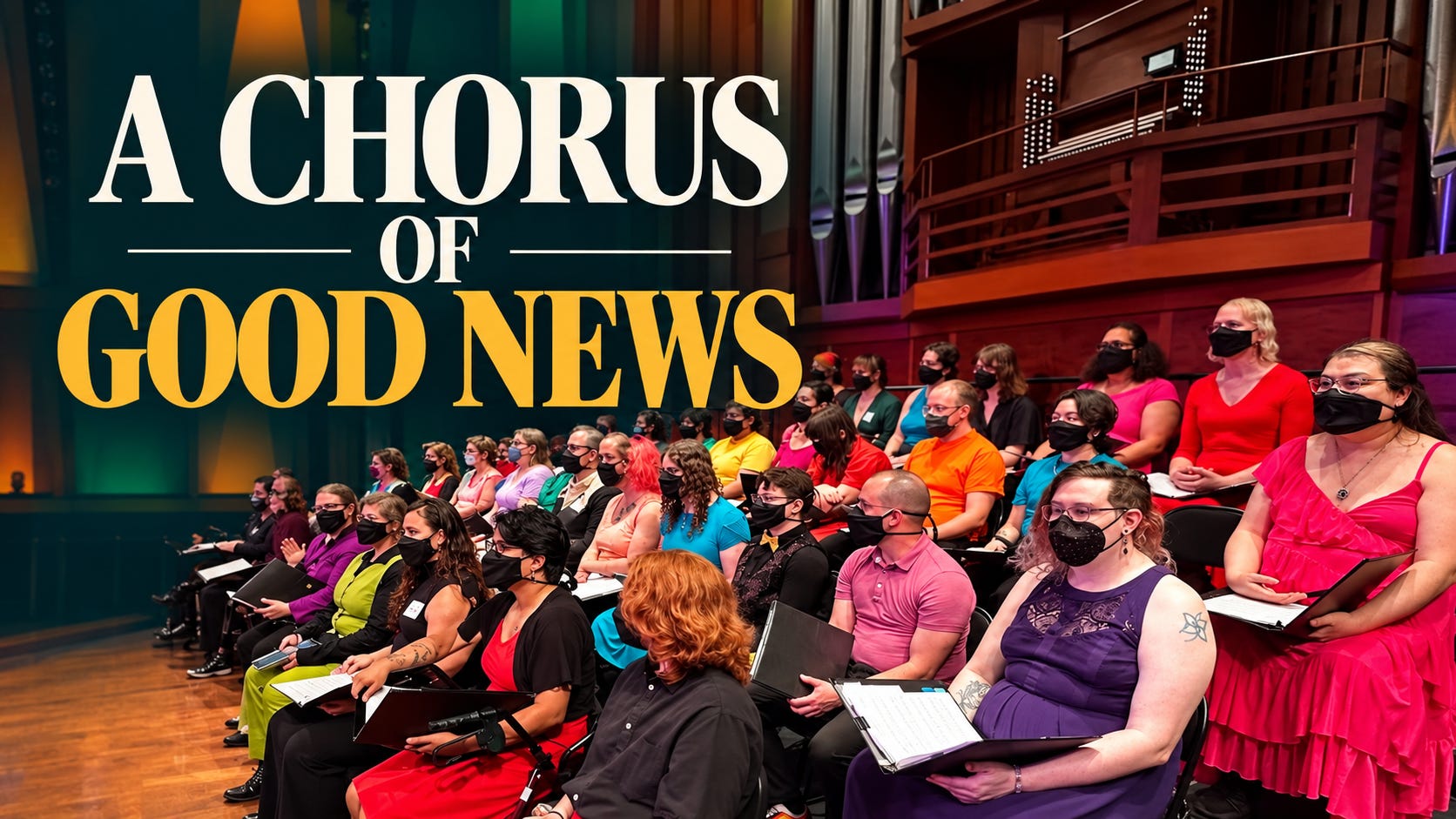
STANCE began as Haven Wilvich’s idea. She’d come out as nonbinary and found almost nowhere in Seattle to sing that felt trans-inclusive, which is a striking gap in a city with a famous music scene and a long queer history. The Seattle Men’s Chorus has been around since the late ‘70s. Many of us who grew up GenX remember gay men’s choruses as one of the most visible, defiant forms of queer community in the AIDS years. Trans singers, though, mostly had to fit themselves into rooms designed for someone else.
Wilvich had the vision, Bolme had the choral expertise, and STANCE gave its first performance on Transgender Day of Remembrance in 2022. It started with barely a dozen members. It now has more than 115, at every skill level, with a weekly rehearsal chorus and a smaller ensemble that does outreach.
Survival hasn’t been guaranteed. In 2024, after a COVID outbreak cancelled one of its Pride concerts and grants came in lower than expected, the choir announced it only had enough funding to last through September and might cease to exist. But it survived. Growth like that, from a group that nearly folded two years in, tells you something about how badly people needed it.
In a news and political cycle that seems determined to make life harder for trans people, here's something worth celebrating: a community that nearly disappeared is now more than 115 singers strong. They haven’t just survived—they’ve grown and thrived.
Now that’s a reason to sing out with joy if I’ve ever heard one.
One member, writing for that 2024 fundraiser, said that for a couple of hours every week they didn’t have to wonder whether their existence was good enough.
Of course it was good enough. But sometimes harmonizing with a room of like-minded friends is just the reminder you need.
STANCE isn’t a youth choir; its singers are adults. But I keep reading this story as a parent, because what these singers describe — the relief of being in a room where nobody’s going to sort you wrong — is what every teenager is looking for, and what trans teenagers are increasingly being denied.
The national picture is grim. Twenty-seven states now ban or substantially restrict gender-affirming care for trans youth, and lawmakers introduced hundreds of anti-trans bills in the first month of 2026 alone. Washington has largely been on the other side of that line. That’s exactly why this November matters so much here.
On the ballot this fall is IL26–001, an initiative that would repeal Washington’s current parents’ rights law and replace it with language lifted verbatim from Louisiana. LGBTQ advocates describe the effect plainly: it would push schools toward forcibly outing trans students to their parents.
I’m a parent, and I want to know what’s going on in my kids’ lives. Most parents do. But a kid who trusts a teacher or a counselor with something before they’re ready to tell their family isn’t keeping a secret from you out of malice. They’re testing whether it’s safe to be who they are. A law that turns every trusted adult at school into a mandatory informant doesn’t make that kid more likely to come to you. It makes them less likely to tell anyone at all.
Trans adults in Seattle have had to build their own rooms, from scratch, because the existing ones weren’t safe. I’d like to keep their younger counterparts from having to wait until adulthood to find one.
Joy and community can work as political acts, and this choir is a living example. You can’t legislate away 115 people singing together. You can make their lives harder, and many states are doing exactly that, but you can’t make them stop showing up for each other on a weeknight in a church basement, meowing at each other until they’re loose enough to sing.
STANCE performs twice a year: once during Pride in June, and once in November, around Transgender Day of Remembrance — the same day it gave its very first concert. This year that concert falls just weeks after Washington votes on IL26–001.
So here’s my ask, parent to parent. Vote this fall like your kid’s privacy depends on it, because somebody’s kid’s does. And then, if you’re in Seattle, buy a ticket to that November concert and bring your teenagers. Let them hear what it sounds like when a room full of people who were told they didn’t fit decided to build a section of their own.
You may see me there with my (choir-loving, gender-ambivalent) child. If you do, please say hello.
Hi, I’m Dana — and I Write Out Loud
I Write Out Loud is my primary home for cultural memoir, personal essays, and live conversations about the strange, brave process of becoming yourself in midlife. If you like essays with a point of view and apex pulse, you’ll find plenty to read there.
And if you enjoyed this story — why not buy me a coffee? ☕
{Make mine a decaf iced oat milk mocha, please!}
Thanks for stopping by!
We’re Dana DuBois and Lawrence Winnerman, lifelong BFFs and co-hosts of The Daily Whatever Show — our independent home for smart, irreverent conversations about culture, politics, media, creativity, relationships, aging, and whatever else is shaping modern life this week.
We’re live every Friday at 10am ET with thoughtful analysis, sharp interviews, cultural commentary, humor, and the kind of conversations that don’t pretend everything is fine when it clearly isn’t.
If you’re enjoying what we’re building, please consider supporting our work with a paid subscription. Your support helps us keep the show independent, book fascinating guests, and continue creating smart conversations with your morning coffee.
We love you — mean it!

Best of luck to STANCE and all the wonderful people who make it happen. And thanks, Dana, for this enlightening piece