


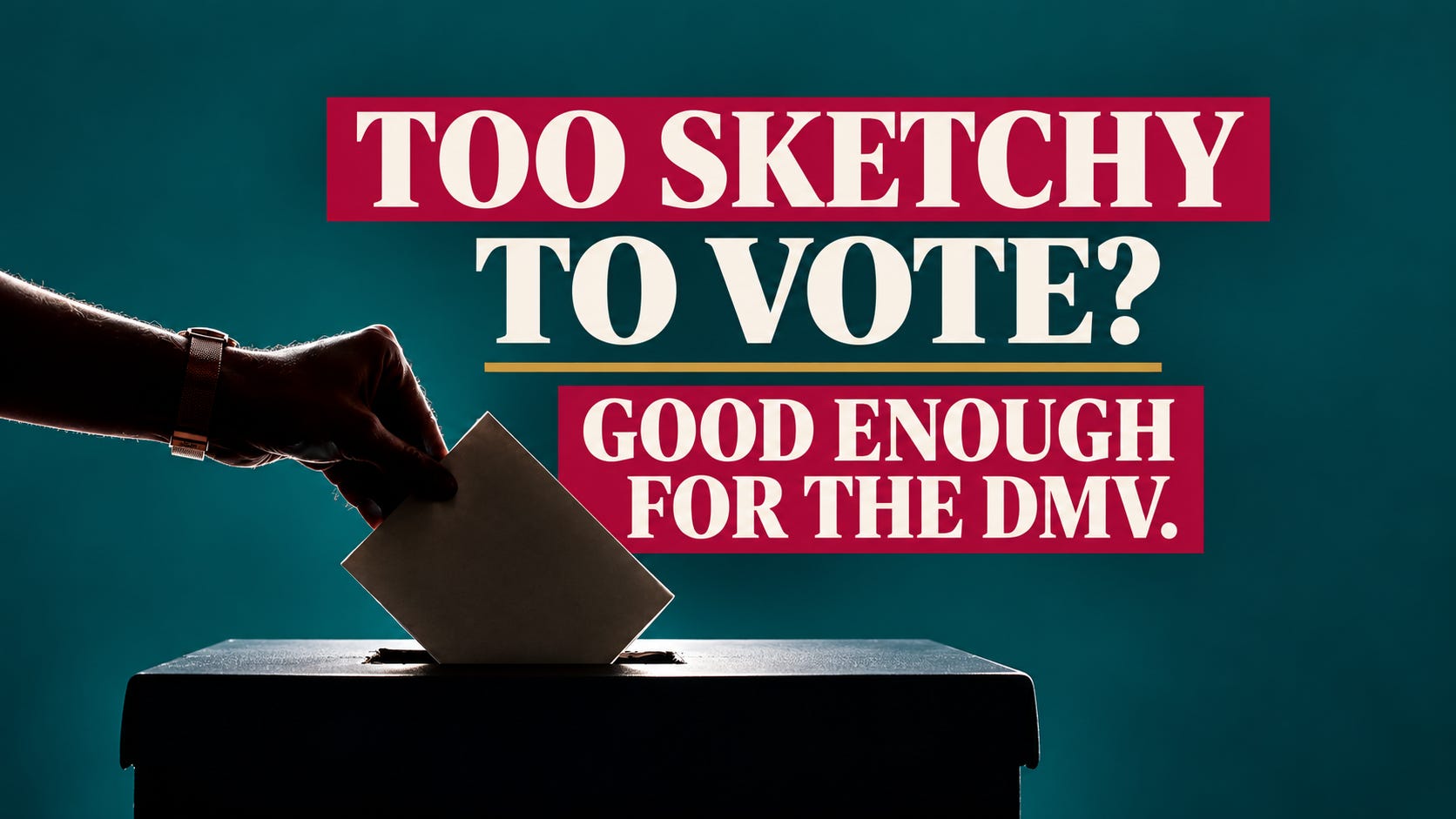
LIVE FREE OR DIE, N.H. (The Daily Whatever Press) — The Supreme Court took a long, hard look at New Hampshire on Thursday, 12 days before an election, and decided the gravest threat to democracy in the Granite State is a laminated card with a college mascot on it.
In an unsigned order, the justices let New Hampshire’s Republican officials go back to treating student IDs as worthless at the polls — not to vote, not as backup evidence, not for anything. The Court paused a lower-court injunction that had forced Secretary of State David Scanlan to revise guidance declaring student IDs unusable for any purpose at all. The stated reason was protecting voters from confusion. The method was flipping the rules back mid-game, which is a hell of a way to un-confuse anybody.
I already wrote about Florida pulling this exact shit, and I’ll get to Florida, because Florida always demands to be gotten to, does it not? But New Hampshire earned its own spotlight, because New Hampshire pulled it off in four steps, with every step dumber than the one before it.
Step one: Write a rule, then get your own rule wrong
House Bill 323, signed by Gov. Kelly Ayotte in April, removed high school, college, and university IDs from the list of acceptable ways for voters to prove who they are when casting a ballot. Student IDs had satisfied the identity requirement from 2012, when the state’s voter ID law was enacted, until HB 323 took effect. Fourteen years of college kids voting with their school IDs, and the republic somehow survived.
Then Scanlan’s office went further than the law did. Its April guidance told election officials not to let residents register with a student ID — but the law only barred student IDs for proving identity when casting a ballot, not for registering. The man in charge of explaining New Hampshire’s election law got New Hampshire’s election law wrong.
Federal Judge Joseph Laplante noticed. And here’s the thing people keep missing: Laplante actually upheld the ban itself at this preliminary stage. He didn’t strike down a goddamn thing. He just ordered the state to describe its own law accurately, and noted that the state had not identified “any security or integrity concern specific to student ID cards.”
Not one. The state’s big worries were that student IDs don’t have expiration dates and many lack holograms and ultraviolet markings. My Blockbuster card didn’t have a hologram either, and nobody ever used it to steal an election.
Step two: Fix it overnight
Here’s where the government briefly, miraculously functioned. Laplante ruled on October 2. By the next day, Scanlan had updated his guidance to say election officials may accept a student ID alongside other evidence at the polls. Done. Posted. Live on the website.
My teenagers take longer to answer a text.
Step three: Tell the Supreme Court fixing it was impossible
Then the state ran to Washington and told the Supreme Court that re-educating election officials and the public on short notice was “practically impossible” — about a correction Scanlan had already made, in a day, on the internet, where everyone could see it.
The district court said no to pausing the order. The First Circuit said no. The Republican National Committee filed a brief backing the state anyway, because of course it fucking did. The plaintiffs — the Coalition for Open Democracy, the League of Women Voters of New Hampshire, and the Forward Foundation — argued that the revised guidance was now the status quo, and a stay would reverse the rules for the second time in a month.
The Court’s majority responded with this: “lower federal courts should ordinarily not alter the election rules on the eve of an election.” That’s the Purcell principle, a rule of thumb that exists so voters don’t show up to find the rules changed out from under them. The Court used it to change the rules out from under them. Twelve days out. That’s a lifeguard holding your head underwater so you don’t get confused about where the water is.
Justice Ketanji Brown Jackson dissented, arguing that the state’s actual election rules were never touched — the lower court had simply required an official to make his public statements match the letter of state law instead of summarizing it in a way that could mislead voters and poll workers. The majority looked at a correction to misinformation and decided the correction was the problem. Bull. Fucking. Shit.
Step four: The DMV ouroboros
So what’s a 19-year-old in Durham supposed to do now? The plaintiffs say the alternative is a $20 non-driver’s ID from the DMV, where offices require appointments, sit more than 30 minutes from campuses like UNH and Dartmouth, and are often open only during class hours. That’s a $20 cover charge to vote, at a venue half an hour away, with doors that only open during your shift.
And here’s the topper. Students can use their existing student ID as proof of identity to get that non-driver’s ID from the DMV. The card the state insists is too sketchy to vote with is perfectly good for obtaining the card you now need to vote. It’s a fraud risk at the polling place and a valid document across the counter at the DMV.
Y’ALL THIS MAKES NO SENSE.
Meanwhile, in Florida
Florida’s version is HB 991. The state had accepted student IDs for more than 20 years before scrapping them, and the repeal takes effect in January 2027. The NAACP sued on October 16. Its complaint takes apart the governor’s excuse that student IDs don’t prove Florida residency, pointing out that passports, military IDs, and concealed carry permits don’t prove Florida residency either — and those all still work. In Florida, a gun permit gets you a ballot and a FAMU ID gets you turned away.
New Hampshire is now one of 11 states that won’t accept student IDs to prove identity at the polls, and Florida makes it 12 in January. This isn’t a glitch in two states. It’s a playbook, and the Supreme Court just initialed a page of it.
What this is actually about
Nobody in New Hampshire caught a single student committing fraud with a student ID. The state confirmed that by failing to name one problem when a federal judge asked. What it has instead is a theory of who should have to work harder to vote, and the answer keeps coming back the same: the kids.
My generation got Rock the Vote and Madonna wrapped in a flag, telling us our ballots mattered. My daughters’ generation gets a $20 DMV appointment during organic chem. And the plaintiffs include the League of Women Voters, an organization founded in 1920 precisely because a lot of very confident men once argued that some citizens were too unreliable to vote.
Live free or die, New Hampshire. Or, if you’re 19, find a ride to the DMV during class and pay $20 for the privilege.
Hi, I’m Dana — and I Write Out Loud
I Write Out Loud is my primary home for cultural memoir, personal essays, and live conversations about the strange, brave process of becoming yourself in midlife. If you like essays with a point of view and apex pulse, you’ll find plenty to read there.
And if you enjoyed this story — why not buy me a coffee? ☕
{Make mine a decaf iced oat milk mocha, please!}
Thanks for stopping by!
We’re Dana DuBois and Lawrence Winnerman, lifelong BFFs and co-hosts of The Daily Whatever Show — our independent home for smart, irreverent conversations about culture, politics, media, creativity, relationships, aging, and whatever else is shaping modern life this week.
We’re live every Friday at 10am ET with thoughtful analysis, sharp interviews, cultural commentary, humor, and the kind of conversations that don’t pretend everything is fine when it clearly isn’t.
If you’re enjoying what we’re building, please consider supporting our work with a paid subscription. Your support helps us keep the show independent, book fascinating guests, and continue creating smart conversations with your morning coffee.
We love you — mean it!
